
Disclosure: As an Amazon Associate I earn from qualifying purchases.
A waterproof indoor door mat should be judged as part of an entrance, not as a promise that the whole floor will stay dry. The surface may absorb moisture or hold it in grooves, while the backing is intended to limit water passing directly through. Water can still reach the floor around the mat, beneath its edges or when the mat is saturated or moved.
Begin with the actual problem at your door: wet shoe prints, gritty debris, a narrow door gap or more than one busy entrance. Then choose a mat whose selected size, backing and care instructions suit the floor beneath it. A waterproof description does not establish floor compatibility, unlimited absorption or slip-free use.
The options below have selected listings that describe waterproof use or backing. Their specifications are published information, not hands-on measurements of absorption, drying time or grip. The buying guide separates these claims and helps you plan placement, cleaning and inspection without assuming that one mat solves every entrance problem.
What waterproof, absorbent and weather-resistant mean here
These words describe different properties. An absorbent surface takes up moisture; a textured scraping surface helps collect debris; a water-resistant or waterproof backing concerns passage through the mat. Weather-resistant describes intended exposure, but does not establish how the mat performs under every temperature or weather condition.
Look for the exact claim in the selected configuration. A general statement about a brand’s other mats cannot prove that this mat has a waterproof barrier. Likewise, the presence of rubber, PVC or TPR does not by itself establish a verified waterproof construction.
Use this simple buying distinction:
- For wet shoes, assess the surface and its manageable cleaning routine.
- For grit, consider the textured surface and how debris is removed.
- For water passing through, check the selected backing’s stated function.
- For the floor finish, consult both the mat and flooring instructions.
- For everyday movement, evaluate flat placement and door clearance.
No single keyword answers all five questions. Keep the mat’s role modest and clear: it is a tool for managing tracked-in moisture and debris at a particular entrance, with maintenance required.
The selected mats
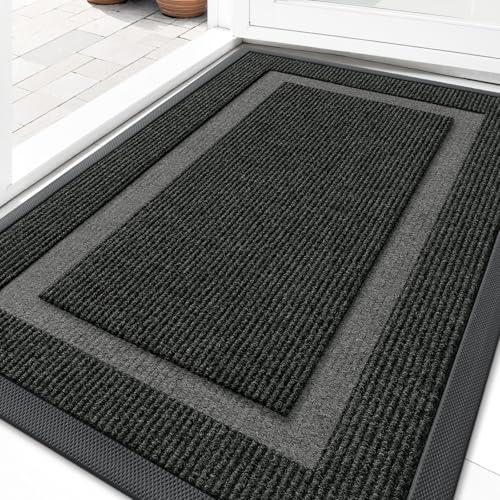
OLANLY black rubber-backed entrance mat, 29.5 by 17 inches
View this selected option on Amazon
The selected black OLANLY configuration is 29.5 by 17 inches, with a natural-rubber backing, woven polyester surface and a listing-described 0.2-inch profile. Its title identifies waterproof backing and indoor/outdoor use. The grooves make it relevant when you want a compact scraping position just inside a suitable entrance.
Check the actual door gap instead of treating the profile as permission to place it under any door. Confirm the floor maker accepts the backing. The listing describes vacuuming, sweeping, shaking and rinsing followed by complete air drying; do not assume it is machine washable. A waterproof backing does not stop water reaching the floor at an exposed edge or eliminate the need to inspect beneath the mat.
Gorilla Grip WeatherMAX Gray Diamond, 29 by 17 inches

View this selected option on Amazon
The selected WeatherMAX configuration is 29 by 17 inches in Gray Diamond, with a listing-described 0.3-inch profile, natural-rubber backing, grooves and a raised retention border. Gorilla Grip’s WeatherMAX information confirms the product family and advises checking surface compatibility and keeping the area beneath dry.
It is worth considering when you want a textured indoor/outdoor mat for an entrance that can accommodate its footprint and thickness. Its border is a design feature, not a guarantee against overflow. The manufacturer’s cautions are particularly relevant: the mat is not suitable for every surface, and wet conditions can leave marks or damage. Choose it only where the mat and floor requirements can both be met.
OLANLY grey stripe entrance mat, 29.5 by 17 inches

View this selected option on Amazon
The selected grey OLANLY stripe mat is 29.5 by 17 inches. Its title describes a waterproof indoor/outdoor mat, while the feature text identifies a polyester surface, recycled-PVC construction and an approximately 0.3-inch profile. It is a separate configuration from the black natural-rubber-backed model above.
This is relevant when the stripe pattern suits your entrance and you want a compact footprint for wiping shoes. Ask about the exact backing and your floor finish before placing it directly on a sensitive surface. The selected listing describes vacuuming, sweeping and shaking; do not import a hose-washing or machine-washing procedure from another OLANLY product simply because the brand matches.
OLANLY grey two-pack, 29.5 by 17 inches per mat

View this selected option on Amazon
The selected two-pack contains two grey stripe mats in the 29.5-by-17-inch configuration. Its listing describes a waterproof indoor/outdoor design, polyester and recycled PVC, and an approximately 0.3-inch profile. It is useful when two suitable entry points need the same type of compact mat.
Measure each location independently before choosing the pack. A two-pack is not automatically a better value if the second mat has no appropriate place or requires a different size. Confirm the permitted cleaning method and floor compatibility for both positions. Two small mats placed together do not become one continuous waterproof surface or a guaranteed barrier against tracked-in water.
Measure door movement, not only the rectangle
Open the door through its normal travel and locate the smallest gap above the floor. Include weatherstripping, a sweep or a raised threshold in the measurement. A mat’s advertised thickness may not account for a curled edge, folded shipping crease or a separate underlay.
Mark the intended footprint on the floor without using a method that could damage the finish. Open the door, carry a bag through and step into the room normally. This helps reveal whether the mat is positioned where shoes actually land or only where it looks centered.
Measure beyond the doorway when planning a wiping area. A mat should offer useful contact space for the way people enter, rather than sit in a position that is routinely stepped over. The selected options here are compact rectangles; do not assume they provide the coverage of a long walk-off runner.
Check nearby doors and furniture too. A closet door, umbrella stand or shoe cabinet can restrict placement. Moving a mat slightly away from the main door may solve one clearance issue while creating another at a cabinet. Test the whole entrance rather than one isolated movement.
Floor compatibility can outweigh a waterproof label
Identify the flooring and, if possible, its brand and care instructions. A backing that is appropriate on one surface may be unsuitable on another. New finishes, particular vinyl products or outdoor deck coatings can have their own restrictions; a broad listing claim does not override them.
For example, Shaw’s luxury-vinyl care instructions advise using mats without latex or rubber backings to reduce possible discoloration. That is a concrete reason to consult your own floor maker, not a claim that every mat damages every floor. Do not choose a rubber-backed product for a floor whose instructions prohibit it.
The Gorilla Grip maker also cautions that WeatherMAX is not suitable for all floor types and that the area beneath should remain dry. Treat that restriction as part of the purchase. A waterproof title does not establish that moisture will never become trapped beneath a mat.
If compatibility is unclear, ask for an answer identifying the actual backing and floor finish. A statement such as “works on hard floors” is less useful than guidance for your particular surface. Avoid adding an unapproved layer beneath the mat to hide an unresolved compatibility problem.
Build a small entrance system around the mat
Think about what arrives with the person entering: wet footwear, umbrellas, bags and perhaps a pet. Decide where shoes will be wiped and removed, where wet items can be placed and how the area will be cleaned. This helps you avoid expecting the mat to manage water that never lands on it.
A compact mat works best when its placement is intentional. Keep the usable surface accessible instead of filling it with a shoe rack or umbrella holder. If objects cover most of the area, you may have bought enough rectangle but not enough useful wiping space.
Consider the transition into the next room. People carrying groceries may take a different path from someone stopping to remove shoes. Test both routes. A mat that is routinely avoided does little for the actual problem, even if its construction is otherwise appropriate.
Avoid turning the entrance into a patchwork of overlapping mats. Overlaps complicate door clearance, drying and flat placement. Use each mat in a position that suits its intended configuration rather than treating quantity as a substitute for a planned arrangement.
Match the maintenance routine to the entrance
Occasional damp shoes and light dust
For a lightly used entrance, choose a mat you can inspect and refresh without a complicated routine. Look at the permitted method for loose debris and how easy it is to lift the selected size. Keep the floor beneath accessible so it can be checked rather than leaving the mat permanently undisturbed.
A compact footprint may be sufficient for this use, but confirm it lines up with actual foot placement. The convenience of cleaning and drying can matter more than a dramatic absorption claim when the daily moisture load is modest.
Frequent rain and gritty footwear
A busy entrance needs a realistic plan for removing captured debris and drying the mat. Grooves can collect grit, but that debris still has to leave the entrance. If the mat becomes wet faster than you can dry it, the ownership plan needs attention rather than a stronger promise in the product description.
Choose a position where wet items can be managed without dripping past the mat. Inspect beneath and around it during wet conditions. A water-blocking backing is not a basin for unlimited rainfall or a reason to ignore a wet floor at the edges.
Two doors with different needs
Evaluate both doors separately. One may have a tight sweep and the other a larger open landing; one may see muddy shoes while the other sees mostly dry foot traffic. The grey two-pack is relevant only if both locations accept that same configuration.
Compare the delivered cost per mat, then ask whether the unused or unsuitable second item has any value to you. A coordinated appearance can be convenient, but it should follow the measurements and floor restrictions, not replace them.
Cleaning instructions should stay with the exact mat
Do not assume all entrance mats can be washed in a machine. Rubber-backed scraping mats, PVC-backed stripe mats and absorbent textile mats can have different care directions. Keep the label or instruction sheet for each selected product so a family member can identify the correct method later.
For WeatherMAX, the maker’s care instructions allow removing loose dirt, spot cleaning or hosing outdoors, followed by air drying, and advise against bleach. Follow the selected mat’s directions and let both the mat and supporting area dry before replacement. Other mats in this guide do not automatically share that procedure.
Plan where rinsing or drying will happen if the chosen method calls for it. A small apartment without a practical drying area presents a different ownership situation from a house with suitable outdoor space. Do not advertise a cleaning method as effortless without considering how it works in the buyer’s home.
Use only permitted cleaners. Stronger chemicals, heat or a dryer setting borrowed from another textile may damage the backing or surface. If you cannot find the care instructions, obtain them before attempting a deep clean. Preserving a waterproof description is not a reason to improvise a washing process.
Check flatness, dryness and wear during use
A non-slip label does not guarantee that a mat remains fixed on every floor in every condition. Dust, water, curled edges, wear and unsuitable placement can change how it behaves. Inspect it as part of maintaining the entrance instead of treating the purchase as a permanent safety measure.
After moving or cleaning the mat, check that the whole rectangle lies flat and the door moves freely. Make sure the backing and floor meet the maker’s required conditions. If the mat catches under the door or forms a raised corner, resolve the placement before continuing normal use.
Look for damage to the surface, edge and backing. If cracks, separation or deterioration appear, ask the manufacturer whether the mat should be replaced. Do not assume the backing still performs as described simply because the top looks presentable.
Keep the inspection practical: lift the mat when appropriate, look at the floor beneath and remove trapped debris using the floor’s own care method. This also helps you catch moisture or marks early. It is more useful than relying on a general promise that a mat protects every type of floor.
Read certification and environmental claims narrowly
A textile or materials certification is not a guarantee against allergies, irritation, slips or every chemical exposure. If a certification influences your purchase, ask for the applicable certificate or label details for the selected product and check what the standard actually covers.
This guide does not treat an unverified certification headline as a reason to call a mat universally safe. Similarly, recycled material or a climate-related claim should not be used to infer waterproof performance, grip or floor compatibility. These are separate questions requiring their own information.
For most buyers, confirmed size, backing, care and placement are the first decision points. Certification details may provide additional information, but they should not distract from an unresolved physical fit or a floor manufacturer’s prohibition.
Compare a complete purchase rather than an advertised bargain
Use the price for the exact selected size, color and pack quantity. Add shipping and any return cost relevant to your seller. A lower price for another size or a single mat cannot be compared directly with the selected two-pack.
Ask about the inspection and return window before ordering. Confirm what happens if a different variant arrives or the door cannot clear the mat. Keep packaging and order details until you have checked the item against the entrance measurements and the supplied label.
Do not assume a warranty establishes a fixed service life under your conditions. Traffic, cleaning, environment and placement differ. Budget for an item that can be maintained in the intended entrance and replaced when its condition warrants, rather than expecting a permanent waterproof solution.
A final checklist for an indoor doorway
Before buying, confirm the selected dimensions and backing, the actual door sweep, the floor manufacturer’s restrictions, the intended cleaning method and a drying location. For a two-pack, repeat the physical checks at both doors. Keep unresolved questions visible instead of filling them with assumptions from another product.
Choose the mat that fits this complete plan. Waterproof wording is one useful piece of information, but the practical result depends on where moisture lands, how the mat is maintained and whether the floor beneath accepts it. A well-chosen entrance mat supports everyday cleaning; it does not replace checking the entrance itself.
Keep the entrance plan easy to repeat
Write down the selected mat’s dimensions, backing and permitted care beside your door measurements. For two locations, keep separate notes so a mat is not moved onto an incompatible floor simply because the other entrance needs cleaning.
Decide who will check the mat after a wet day and where it can dry when necessary. The aim is a manageable household routine, not a rigid calendar that assumes every entrance has the same traffic. More frequent inspection can be useful when rain, grit or repeated door contact changes the conditions.
Store the label and invoice with the order details. If a backing starts to deteriorate or a replacement is needed, the exact configuration is easier to identify. That small amount of preparation supports the mat’s intended job without relying on broad promises about permanent protection or maintenance-free use.